
Slint
Spiderland

Slint Spiderland
Touch and Go Records; Released March, 1991
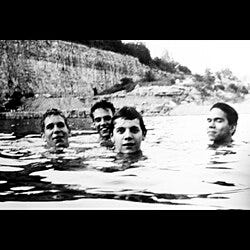
1991 Review:
Got some contenders here. (Slint as in, your girlfriend’s Slint?) Side two begins with a song called “Washer”. It’s rhythmic like lying in bed late on Saturday while your mom washes clothes in the laundry room, many rooms away. Maybe not. Never have I heard a record that so effectively manipulated the decibel spectrum. Major league recording quality. Someone must have some cash. Maybe not. Slint has the timing and writing capabilities of Pink Floyd. Haunting and methodical grunge influenced trippiness. I recommend this album.
2025 Re-Review:
When HypeV2 senior editor [read: “dork”--Ed.] Flaggert hollered at me a day before my first re-review was due, I was lucky. Not to be hollered at by a tenured high school English teacher treating me like the stoner B-minus student I was in 1984--no. I was lucky because of the assignment.
Flaggert’s idea was: “Let’s check out reviews we wrote in Hype 35 years ago, and re-review the same records now!” Fun idea, and it worked out well for me because the very first record I ever reviewed in Hype was Spiderland by Slint. That review came out in the very first issue, in June of 1991.
The record went on to be legendary.
Thank god I gave it a good review.
Spiderland, the second record from Louisville, Kentucky’s, post-hardcore prodigy Slint, hardly got any notice when it came out--the band broke up just months before the release. It received little publicity, and there was no band to provide tour support.
Reviews were few and far between, and mostly mediocre (with the exception of a glowing one from the legendary Steve Albini, producer of the band’s first record, Tweez, writing for Melody Maker).
Today Spiderland is widely considered to be one of the most important records of the 1990s.
The record has just six songs, clocking in at just under 40 minutes. This 40-minute post-hardcore concept album is successful in a way that these early 20-somethings had no business being able to pull off.
Slint was Brian McMahan on vocals and guitar, David Pajo on guitar, Todd Brashear on bass guitar and Britt Walford on drums.
Walford emerges as kind of the driving force in the band, with McMahan coming a close second. They grew up together and one can sense the brother-like magic that can drive bands to greatness. The signature halting, jarring rhythms also seem drummer-engineered.
The entire vibe of the record hits in the brilliant opening track “Breadcrumb Trail.” Crazy meter, fantastic drumming, incredible dissonant, minor crunchy chord progressions.
McMahan’s vocals, from mumbled spoken word to screaming, are at once boyish, longing and frustrated. Turns out they never had finished lyrics until the day the record was made.
The post-punk dynamic of ‘quiet/loud/quiet’ that would launch Nirvana into the stratosphere the following year is right here too—but in a more complicated, less pop-rock envelope.
The Q/L/Q dynamic is stunningly well recorded, as it must be to work. The project, from tracking to mastering, is exceptional for an indie band’s second record. It’s the work of Brian Paulson, who would go on to record all kinds of critical Chicago/midwest artists.
As above, “Breadcrumb Trail” sets up the whole record. Quiet, gorgeous minor chords, sick drumming and crazy tight breaks sounds like lots of practice (five days a week apparently) in the basement of Walford’s suburban Kentucky home.
“Nosferatu Man,” track two, doubles down on the odd meter time signature style that would come to be known as ‘math rock.’ A song in two acts, and the second part may be my favorite part of the record—an off-count rhythmic dirge, brilliantly drummed. Walford references Rachmaninoff when discussing it.
“Don Aman,” track three, is the least interesting of the songs—but is still beautifully minor and with a satisfying build. Lyrics come off a bit…youthful.
“Washer” is next. Gorgeous guitar/bass intro. “Wash yourself in your tears / and build a church on your faith.” Takes a while to get to the “L” in Q/L/Q, but when it does arrive, it pays off.
“For Dinner” is a gorgeous sleeper that preps for the last and best song on the record, “Good Morning Capitan.” “Captain” has sublime drumming, and such odd, great guitar parts. The most downloaded Slint track on Spotify for good reason.
---
35 years later, it has been interesting to consider the influences. One can hear the DC and midwest hardcore here. Albini’s influence must have been powerful on these kids. (Britt lived in Albini’s house for a time).
I even got a strange sense of Neil Young—which didn’t make sense, but I later read that Albini referenced Crazy Horse in his original review of Spiderland. Slint would go on to cover “Cortez The Killer” at live shows.
But beyond these influences, this record is remarkably original. It’s certainly not hardcore, but it certainly may be the beginning of post-hardcore.
There is a pretension to this record, for sure. It shows up in the lyrics at times. But it’s the kind of pretension born of being young, and being smarter than everyone around you. These guys profile as the type of kids who achieve brilliance really young—and proceed to go mad shortly thereafter. And, in fact, at least one of them (Brian) did go mad to some degree according to the excellent 2014 Slint documentary “Breadcrumb Trail” by Lance Bangs.
I never stopped listening to Slint. I still have both records on vinyl. Of course when Ol’ Man Flaggert assigned this, I was obliged to give it a careful re-listen and pay attention. What came was admiration. Particularly of the sophistication of the record and the incredibly young ages of the fellas involved.
P.S. It sure is easier writing about bands with the internet…thanks to Wikipedia and Lance Bangs for making this easy.
-- Moe
 |
|